
The Timeless Pair: China, India, and the New Delhi Moment
By Himadrish Suwan / September 15, 2026
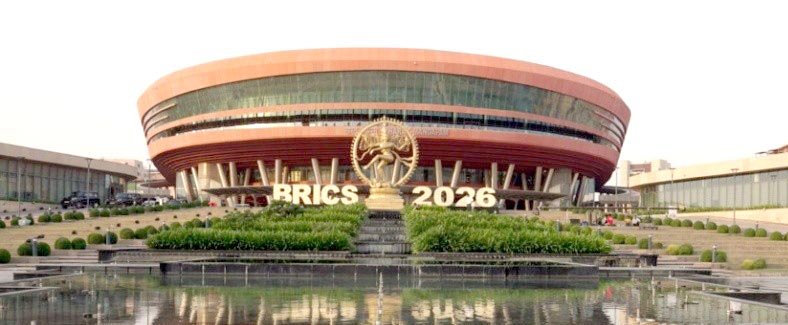
Bharat Mandapam convention center is all set to host the 18th BRICS Summit in New Delhi, India, September 10, 2026.
As chairman of the Confederation of Young Leaders of India, I believe one dimension deserves substantially greater attention: youth and people-to-people engagement.
The long-term China-India relationship could not be sustained through governmental engagement alone. The two countries are home to hundreds of millions of young people, students, researchers, entrepreneurs, innovators, and emerging leaders, yet opportunities for meaningful interaction between young Indians and Chinese remain few and far between.
We need more university partnerships, student exchange activities, young leader dialogues, research collaborations, cultural programs, and entrepreneurial networks connecting young generations in both countries.
Young people should not inherit outdated perceptions of one another. They should be given opportunities to meet, debate, collaborate, and understand each other’s societies directly.
My own engagements with Chinese institutions and young people have only reinforced my opinion that there is considerable curiosity about India in China, just as there is considerable interest in understanding China among young Indians.
Institutionalizing such engagement within the broader BRICS framework could be particularly valuable. A stronger BRICS youth architecture can connect young leaders not only from China and India, but also from across its increasingly diverse membership.
Beyond New Delhi
Summits create political direction, but institutions, businesses, universities, social organizations, and citizens must transform that direction into lasting cooperation.
For China and India, this means continuing dialogue even when circumstances are difficult. It means expanding areas of practical cooperation while addressing differences responsibly. Above all, it means recognizing that neither geography nor history allows these two civilizations to remain indifferent to one another.
India’s timeless philosophy of Vasudhaiva Kutumbakam (the world is one family) offers a valuable principle for this moment, which finds a natural echo in China’s vision of a community with a shared future for humanity.
A multipolar world should not become more divided. BRICS should not define its success based on opposition to any country or grouping. Its greater contribution can be to advocate a global architecture that is more representative, inclusive, and responsive to the aspirations of developing societies.
China and India have assumed a special responsibility within that endeavor. The relationship between the two countries will inevitably encounter moments of complexity. Yet history should encourage leaders to take a longer view. Civilizations measured in millennia should have the confidence to navigate differences measured in years.
As BRICS moves beyond the New Delhi summit, the challenge becomes larger than drafting declarations or expanding institutional mechanisms. It is about building cooperation habits and creating constituencies for peace, development, and dialogue.
If China and India can steadily expand mutual understanding while responsibly managing their differences, their cooperation can become a powerful force for stability and development—not only for Asia, but also for the Global South and the wider world.
The author is chairman of the Confederation of Young Leaders of India.
(The content is provided by Beijing-based China-India Dialogue.)