Two Roads, One Destination: India, China and the Next Chapter of BRICS
In September 2026, leaders will convene in New Delhi for the 18th BRICS Summit, with India serving as the host nation. This year’s theme will be “Building for Resilience, Innovation, Cooperation, and Sustainability.” This summit represents an evolution from the original five-member group established in 2009. BRICS has now expanded to include Egypt, Ethiopia, Iran, the UAE, and Indonesia. Additionally, a partner tier includes nearly ten other countries, such as Belarus, Kazakhstan, Nigeria, Malaysia, and Vietnam. BRICS+ collectively accounts for nearly half of the global population and, by purchasing power parity, represents a larger share of global output than the G7. Therefore, it is no longer just a discussion forum. Instead, it has become a constituency, and constituencies ultimately seek to achieve their objectives.
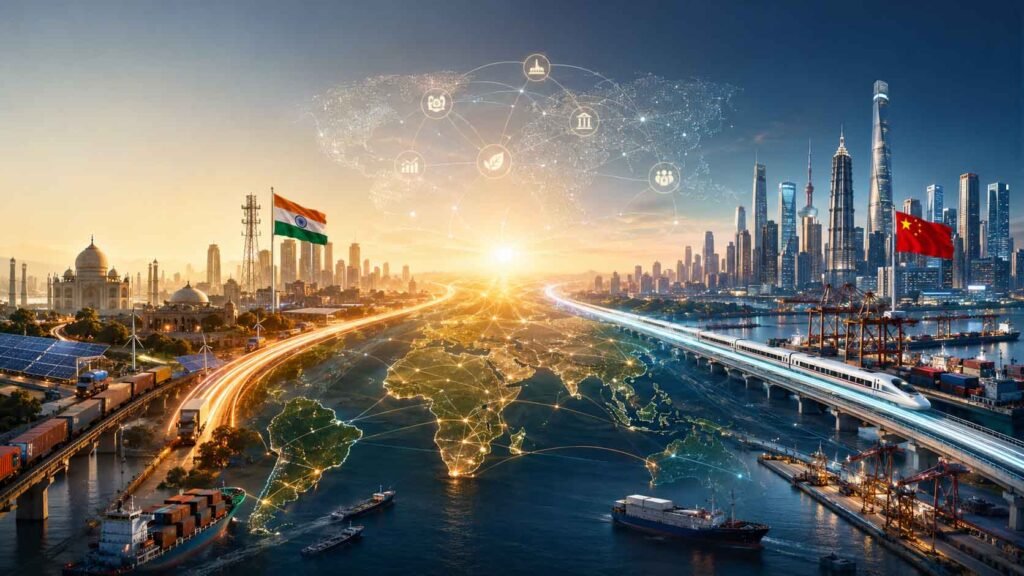
In the context of global economic dynamics, India and China should be considered as complementary engines of growth rather than mere competitors vying for popularity among the Global South or Beijing’s chequebook against Delhi’s charm. Rather, their respective development strategies offer different yet harmonious perspectives. BRICS serves as a valuable platform to integrate and leverage complementary approaches for mutual benefit.
Different instruments, identical objective
China’s economic model is built on scale and delivery. The Belt and Road Initiative has moved somewhere around $1.4 trillion in construction contracts and non-financial investment across more than 150 countries, and 2025 was a record year for new engagement.
China–Africa trade has reached around $300 billion, and zero-tariff treatment, initially extended to 33 least-developed countries under FOCAC 2024 alongside an RMB 360 billion commitment, has since been extended to all 53 African partners. Beijing’s initiatives for global development, security, civilisation, and governance create a framework that guides these activities.
India’s approach focuses on three key areas: infrastructure, accessibility, and human resources. The EXIM Bank provides credit lines totalling about $27–33 billion to around 60 to 65 countries. Since 1964, the ITEC program has trained officials and technicians from over 160 nations. Through the Vaccine Maitri initiative, India has sent about 301 million vaccine doses to more than 100 countries. Additionally, India’s duty-free tariff preference scheme for least developed countries (LDCs) has covered nearly 98 per cent of tariff lines since 2008. Most importantly, India’s Digital Public Infrastructure includes Aadhaar, which serves over 1.4 billion people, and the UPI, which processed a record 23.66 billion transactions worth nearly ₹30 lakh crore (USD 360 billion) in July 2026. This system offers partner countries an open, flexible, and independent model instead of a proprietary platform. Furthermore, India has positioned itself as a convener, amplifying developing nations’ concerns through Voice of the Global South Summits. Rather than competing dollar for dollar, India offers a partnership model that focuses on shared strength and technological empowerment.
Where convergence is already proven
Both countries share a history of productive collaboration, although this is seldom highlighted in reports. Together, they champion the principles of common but differentiated responsibilities in climate negotiations, advocate for special and differential treatment at the WTO, and secured the public stockholding peace clause at the Bali conference. They also express a united stance against unilateral carbon border adjustment measures. The India–South Africa TRIPS waiver proposal from October 2020, which received China’s support, yielded a modest yet tangible outcome at the WTO by June 2022, demonstrating that coalitions within the Global South can effect change within entrenched systems.
In global governance, India and China share common interests in reformed multilateralism. Both nations remain underrepresented in institutions like the IMF and the World Bank relative to their economic weight. The Global South still holds well under 40 per cent of IMF quota shares. China holds 6.40 per cent and India 2.75 per cent, against a US share of roughly 17.4 per cent and an effective veto. The 16th General Review raised total quotas to SDR 715.7 billion without redistributing influence. They both understand that bilateral competition alone won’t resolve this; only coordinated pressure will.
Yet, their approaches to certain systemic changes, such as de-dollarisation, reveal internal heterogeneity. China is promoting the internationalisation of the renminbi and conducts most of its bilateral trade with Russia using national currencies, while India takes a more cautious approach. Although New Delhi has expanded rupee-denominated settlements to bypass friction, it maintains that it has no strategic interest in actively undermining the US dollar, reflecting a more cautious integration into the global financial system.
Conclusion
The 2026 BRICS Summit in New Delhi offers an invaluable opportunity to reshape the dialogue around Global South development by focusing on constructive collaboration rather than ideological competition. Addressing the significant $4 trillion annual financing gap for the Sustainable Development Goals (SDGs) calls for a strategic partnership between the world’s two largest developing economies—India and China. By harnessing the multilateral framework of BRICS and the New Development Bank (NDB) to build trust, these nations can turn structural vulnerabilities into valuable resources.
The proposed agenda emphasises a proactive approach: transitioning from restrictive trade policies and geopolitical grandstanding to fostering actionable, technical public goods. Initiatives like modular digital infrastructure, human capital development, and green manufacturing partnerships exemplify this shift towards sustainable capacity building, aiming to enhance resilience rather than create dependencies. Ultimately, the success of this summit will hinge on our ability to prioritise shared economic resilience and third-market development, cultivating collaboration over bilateral frictions.
Two Roads, One Destination: India, China and the Next Chapter of BRICS Read Post »