
Trump’s Tariff and A Tensed World | COGGS|
REPUBLICAN PRESIDENT DONALD Trump’s return to the White House has united the nations of G7 to the G77 blocs in anxiety over tax and tariff issues. Trump, a Republican with a protectionist pedigree of his party, is known for popularizing the unpopular opinions and mainstreaming defiant stances. Tariff is the most favourite word in his vocabulary, with Trump himself identified himself as a “Tariff man.” His admiration for President McKinley, the 25th President of the USA, is well-known. McKinley is famous for his signature tariff initiative, the Tariff Act of 1890. The Ohio congressman-turned-president also signed the Dingley Tariff, named after Nelson Dingley, a congressman from Maine. One of President Trump’s most remarkable economic strategies was the adoption of protectionist policies aimed at reducing the U.S. trade deficit and reshoring manufacturing jobs.
Trump’s Tariff
As a presidential candidate, Trump advocated for broad tariffs: a 20% tax on imports from all countries including that of global south, a 25% tariff on goods from Mexico and Canada, and a steep 60% levy on products from China. Observers have debated the severity of these developments. He also announced his intention to leverage tariffs as a negotiating tool, targeting nations like Denmark to pressure them into making concessions—such as ceding control of Greenland to the United States. Home is his fort, and to ensure that comfort zone, he may abandon promises made by his predecessors. Right after assuming office, the President threatened to impose a 25% tariff on Mexico and Canada, his two immediate neighbors and major trading partners.
Europe and Trump
The EU has a cherishable trade surplus with the U.S., with the U.S. having a trade deficit of about $161.6 billion in 2023, according to Eurostat data. The U.S. is the largest trade and investment partner of the EU, as well as its main source of foreign direct investment (FDI). Germany and Italy are major exporters to the U.S., and these countries would be deeply affected by any restructured trade arrangement. Brussels would likely unite in response if this happens. Despite being a significant (about 46%) LNG exporter, the U.S. is likely to woo EU nations to import more oil in line with Trump’s “drill, baby, drill” slogan. The arms-import watchdog SIPRI has predicted that, under Trump, EU and NATO nations will stockpile U.S. supplies for their armaments. This trend has already been visible after Ukraine was besieged. Trump will eventually encourage American defence manufacturers to explore Global South markets in coming years.

There is a perception in the air that several EU nations won’t comply with the Undertaxed Profit Rules (UTPR). According to the market experts, President Trump will likely add 10% tariffs on imports other than those from China. While the tariffs fluctuated, at one point, they reached as high as 60% on some Chinese goods. These tariffs were intended to punish China for unfair trade practices, intellectual property theft, and currency manipulation, while incentivizing U.S. manufacturers to bring production back home. However, this approach led to tensions with China, which retaliated with tariffs of its own on U.S. goods, including agricultural products like soybeans, corn, wheat, pork, beef, and other commodities.
Job Creation in the U.S. and Work Visa
In his maiden term, President Trump’s economic policies focused on bringing manufacturing jobs back to the United States. The US China trade war further led to the loss of 245,000 U.S. jobs, according to the U.S.-China Business Co uncil.
In his earlier tenure, Trump sought to restrict and minimize immigration, particularly through more stringent visa policies. His administration focused on curbing the H-1B visa program, which allowed highly skilled workers from countries like India and China to take jobs in tech and other specialized fields in the U.S. Trump’s administration made efforts to make these visas harder to obtain, arguing that they displaced American workers. While this created pressure in high-tech industries, it also spurred efforts to increase domestic training programs and promote automation. Rust Belt states like Michigan, Ohio, and Pennsylvania are expected to bring more changes for revenues.
The Panama Canal
Trump’s approach to global infrastructure projects was another source of contention. The Panama Canal, a strategic waterway for global trade, became an area of focus under the Trump administration. Trump’s rhetoric often suggested that U.S. interests should have a greater say in Panama’s operations, even hinting at a reevaluation of U.S. involvement in the canal’s security and operations. On the social media platform X (formerly Twitter), José Raúl Mulino, President of Panama assured that Panama Canal would maintain sovereignty.
US Dollar Hegemony
Trump’s protectionism was also reflected in his stance on alternative currency plans by BRICS nations. A long-term consequence of Trump’s foreign policies has been the growing trend of countries attempting to bypass the U.S. dollar in international trade transactions. Nations like Russia, China, and Iran have increasingly sought to use alternative currencies for trade, reducing their dependency on the dollar.
China, for instance, has pushed for the use of the yuan in global trade agreements, particularly with countries in Asia and Africa. The rise of digital currencies and regional trade agreements that use non-dollar currencies further highlights this shift. While the U.S. dollar remains the dominant global reserve currency, Trump’s protectionist policies and sanctions may have accelerated this diversification of global trade. Currency-trade is trending but Trump administration is bound to take strict measures if the de-dollarisation threats US dollar hegemony.
Trump’s Impact on the Supply Chain and Mobility Costs
The Trump administration’s protectionist approach had a significant effect on global supply chains during his first term. Tariffs, particularly those on Chinese goods, disrupted long-standing trade relationships and forced companies to reconsider their manufacturing locations. The cost of mobility, particularly in terms of shipping and logistics, increased as companies faced higher tariffs and delays due to trade tensions. In industries like automotive and electronics, U.S. companies found themselves paying higher prices for raw materials and components. Additionally, the increased cost of labour due to visa restrictions in certain sectors, such as tech, also pushed companies to reevaluate their workforce strategies. Trump administration will review these two concerns widely.
Foreign Direct Investment Under Trump
Trump’s foreign policy, particularly his stance on tariffs and international trade agreements, noticeably affected foreign direct investment (FDI) in the U.S. On one hand, some investors were attracted to the U.S. due to the promise of a more favourable corporate tax environment. On the other hand, the trade war and unpredictability in policy made the U.S. a less attractive destination for certain foreign investments, particularly from countries caught in the crossfire of tariffs.
Technology Transfer and Technological Access: A Battle for Innovation
One of the key aspects of Trump’s trade war with China was the issue of intellectual property rights and technology transfer. Trump pushed for stricter regulations that would limit the transfer of sensitive technologies to China, citing concerns over national security and the protection of U.S. technological supremacy.
The U.S. administration under Trump took a harder line on Chinese tech giants like Huawei, accusing them of stealing intellectual property and posing security threats. At the same time, Trump’s policies raised concerns about the future of global technological collaboration and the ease with which companies could operate in international markets. His stance on TikTok also attracted attention, with Trump directing a postponement of the ban by 75 days.
In his second term, Trump may revise the Biden administration’s decision to remove Cuba from the list of state sponsors of terrorism. His policies often involve rechristening, removal, and re-installation. His administration is also likely to impose sharp sanctions on Venezuela. Under his administration, the Gulf of Mexico is set to be renamed the Gulf of America, and Alaska’s Mount Denali is expected to revert to being called Mount McKinley—honouring the 25th American president whose tariff policies inspired him. The value of Bitcoin is expected to rise significantly. Trump has kept significant focus on the southern border to reshape the US foreign policy. His policicies surrounding Mexican drug cartels and illegal immigration led to increased border enforcement and the construction of a physical border wall. Despite the controversy surrounding his immigration policies, Trump’s administration is destined to take a defiant stance to curb drug trafficking and organized crime. While protectionist measures like high tariffs on China will reshape global trade, such measures also led to new alliances and competition in global markets. At home, Trump’s job creation strategies are regionally targeted, particularly in industrial states, but the initiatives will also encounter challenges due to restrictions on immigration and labour mobility.



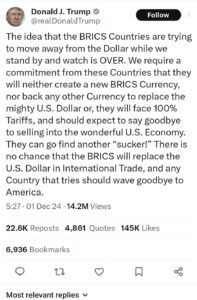 , US President-elect Donald Trump issued a stark warning that he would impose 100% tariffs on the BRICS nations—Brazil, Russia, India, China, and South Africa—should they attempt to establish a currency rivaling the U.S. dollar. Trump’s threat to use tariffs as a blunt instrument against economic shifts highlights his longstanding preference for trade protectionism as a tool for economic growth. Throughout his presidency, Trump advocated tariffs as a mechanism to bolster domestic industries, create jobs, and increase government revenue. However, the consequences of such measures, including increased costs for U.S. consumers, have raised questions about their long-term effectiveness. As BRICS nations seek alternatives to the U.S. dollar, the dynamics surrounding dollar dominance are evolving—an issue that warrants a more sophisticated approach than simply retaliatory tariffs.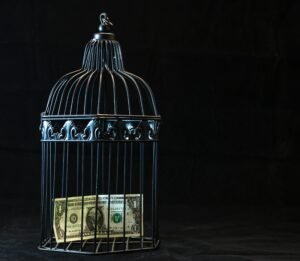
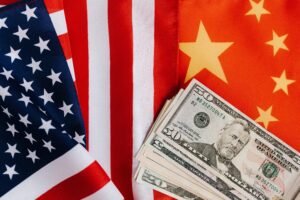 e. China’s bonds were priced just 1-3 basis points (0.01-0.03 %) above U.S. Treasury rates, enabling China to borrow in U.S. dollars at nearly the same cost as the U.S. government. This narrow spread is unprecedented for a non-U.S. sovereign issuer. Typically, even countries with top-tier credit ratings pay a premium of 10 to 20 basis points over U.S. Treasuries when issuing USD bonds. This achievement highlights China’s improved creditworthiness and growing appeal to global investors.
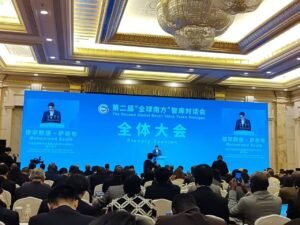 , on November 14th, Mohammed Saqib, Convenor of the Center for Geoeconomics for the Global South (COGGS), eloquently outlined the transformative potential of South-South Cooperation in advancing sustainable development and promoting global equity. He argued that the traditional North-South development paradigm is increasingly obsolete, and that South-South cooperation—defined by collaboration among developing nations—has emerged as a pivotal mechanism for achieving shared prosperity and addressing common challenges.
 Balaji Chandramohan