From Geopolitics to Geoeconomics: A Defining Moment in World Affairs
The international system is undergoing one of the most profound transformations since the end of the Cold War. The assumptions that shaped global politics for more than three decades—Western dominance, unipolar power, and a rules-based order led primarily by the United States—are increasingly being questioned by emerging realities.
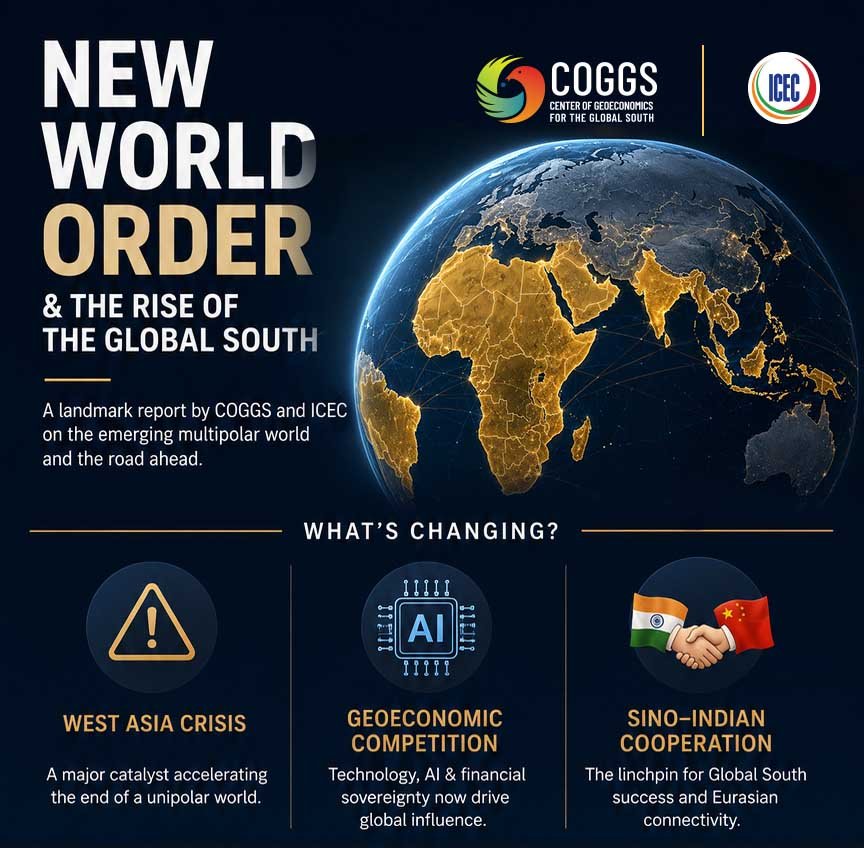
Against this backdrop, the Centre of Geoeconomics for the Global South (COGGS) and the India-China Economic and Cultural Council (ICEC) convened a landmark international dialogue titled.
“The New World Order: Challenges, Transitions, and the Rise of the Global South.” Bringing together diplomats, scholars, defence analysts, economists,
and policy experts from across Asia, Europe, the Middle East, and Latin America, the discussion sought to answer a critical question: What will the next global order look like, and what role will the Global South play in shaping it?
The consensus was clear: the world is entering a multipolar era where geoeconomics, technological innovation, and regional cooperation increasingly define power.
West Asia Conflict: More Than a Regional Crisis
The ongoing conflict in West Asia has emerged as a powerful accelerator of global change. Participants argued that the crisis is not merely a confrontation involving regional actors but a structural turning point exposing the limitations of existing security arrangements and global governance mechanisms.
Several experts highlighted how the conflict has revealed vulnerabilities within traditional Western alliances while simultaneously creating space for regional actors to pursue greater strategic autonomy. Countries across West Asia are increasingly seeking diversified partnerships, balancing relations among major powers rather than aligning exclusively with one geopolitical bloc.
The discussion also underscored the growing importance of connectivity, diplomacy, and development-oriented cooperation over military confrontation. The future stability of the region, participants argued, will depend less on coercive power and more on inclusive economic development, infrastructure integration, and cooperative security frameworks.
The Shift from Military Power to Geoeconomic Power
One of the most significant themes emerging from the dialogue was the transition from a military-centric world order to one increasingly shaped by geoeconomic influence.
Power today is no longer determined solely by military alliances or battlefield capabilities. Instead, it is increasingly measured through control of supply chains, technological innovation, financial infrastructure, energy networks, artificial intelligence, and digital ecosystems.
The rise of alternative financial systems, expanding regional trade arrangements, and growing efforts to reduce dependence on the US dollar illustrate a broader restructuring of the global economy. Simultaneously, investments in renewable energy, advanced manufacturing, and digital infrastructure are creating new centres of economic gravity across Eurasia, Asia-Pacific, and parts of the Global South.
This transformation reflects a deeper reality: economic resilience and technological sovereignty have become central pillars of national power in the twenty-first century.
Multipolarity Is No Longer a Future Scenario
For many years, discussions about multipolarity remained largely theoretical. Today, they are increasingly grounded in observable realities.
The global economic centre of gravity continues to move eastward. Emerging economies are accounting for a larger share of global growth, while regional organisations and multilateral platforms are becoming more influential in shaping international outcomes.
Experts participating in the dialogue noted that China, India, the Gulf states, Southeast Asia, and several emerging powers are playing increasingly significant roles in global governance, trade, finance, and technology. Rather than a world dominated by a single power, the emerging landscape is characterised by multiple centres of influence operating simultaneously.
This shift does not necessarily imply confrontation. Instead, it presents an opportunity to build a more balanced international system where diverse voices contribute to decision-making processes.
The Global South Moves from Observer to Architect
Perhaps the most transformative development discussed during the forum was the growing agency of the Global South.
Historically, many developing nations were often viewed as passive recipients of decisions made elsewhere. That perception is rapidly changing. Countries across Asia, Africa, Latin America, and the Middle East are increasingly shaping global debates on trade, development, climate action, technology governance, and international finance.
The Global South is no longer simply responding to global events; it is actively influencing them.
Participants emphasized that development, stability, and economic cooperation must take precedence over ideological divisions. As geopolitical competition intensifies among major powers, the Global South has an opportunity to advocate for a more inclusive and equitable international order that prioritizes shared prosperity and sustainable development.
Why India-China Relations Matter to the Future World Order
Among all the themes discussed, none generated greater attention than the future of India-China relations.
Despite geopolitical tensions and persistent trust deficits, experts repeatedly stressed that cooperation between Asia’s two largest economies remains indispensable for a stable multipolar world.
India and China collectively represent more than one-third of humanity. Both are central to global supply chains, technological innovation, renewable energy transitions, and economic growth. Their ability to manage differences while expanding areas of cooperation will significantly influence the trajectory of the twenty-first century.
Economic data already points to substantial interdependence. Growing trade volumes and shared interests within platforms such as BRICS indicate that pragmatic engagement remains possible despite strategic disagreements.
Participants argued that major Eurasian connectivity projects, green technology transitions, and broader Global South initiatives will achieve their full potential only when India and China establish greater strategic trust and cooperation.
Beyond the End of History: Entering the End of Ideology
The dialogue concluded with a powerful reflection on the nature of contemporary global transformation.
The post-Cold War belief that history had reached its final ideological destination has clearly faded. What is emerging instead is a more complex world where countries increasingly prioritize national interests, development objectives, economic resilience, and strategic autonomy over rigid ideological alignments.
The emerging international order resembles a vast and unfinished puzzle. No single country possesses all the pieces. No single model offers all the answers.
The challenge for policymakers, scholars, and leaders across the Global South is not simply to react to change but to shape it.
Conclusion: A Historic Opportunity for the Global South
The transition toward a multipolar world is no longer speculative—it is underway.
The defining questions are no longer whether the global order will change, but how rapidly it will evolve and who will influence its direction.
For the Global South, this moment presents an unprecedented opportunity. By strengthening regional cooperation, investing in technological and financial sovereignty, promoting inclusive development, and supporting constructive diplomacy, developing nations can help build a more balanced and representative international system.
The rise of the Global South is not merely a geopolitical trend. It is one of the defining forces shaping the future of global governance, economic development, and international stability.
As the world navigates this historic transition, the choices made today will determine whether the emerging New World Order becomes a source of greater fragmentation—or a foundation for a more equitable and cooperative future.